FlexiSpec®

Spectroscopy Fiber Probes & Probe Couplers

FlexiRay®

Fibers | Cables | Bundles | Accessories

FlexiService

Loan & Installation | Measurements Training | Repair | Development
News
Latest News
27 April 2026
Introducing the FlexiSpec Combi Fiber Optic Probes

In the demanding fields of bio-pharma and advanced R&D, real-time data is essential. Traditionally, securing comprehensive analytical data meant physically switching between different spectroscopic setups, such as ATR, NIR, and Raman. This fragmented approach not only slows down critical processes but also introduces a higher risk of sampling errors. Why run three separate analyses when […]

Read more
17 March 2026
Application Note: Identification of Organic and Pharmaceutical Powders

Real-time, in-line powder identification usually means a trade-off between speed and accuracy. We proved it doesn't have to. We recently teamed up with our Nynomic Group partner, m-u-t GmbH, to release a joint Application Note. The goal was simple: build a compact, field-ready NIR setup capable of analyzing complex organics directly in the bulk material, […]

Read more
Latest Events
21 May 2026
View on EPIC Technology Meeting on Optical Fiber Sensors at Airbus

We recently had a fantastic time attending the EPIC Technology Meeting on Optical Fiber Sensors, hosted at Airbus in Hamburg. The event provided excellent networking opportunities with major companies in the aviation sector and served as a great platform to discuss the future of aerospace sensing. During the meeting, our Product Line Manager, Joachim Gerike, […]

Read more
15 May 2026
EPIC Technology Meeting on Optical Fiber Sensors at Airbus | 19-20 May 2026 | Hamburg, Germany

We are currently in Hamburg attending the EPIC Technology Meeting on Optical Fiber Sensors, hosted at Airbus. This gathering is a fantastic opportunity to connect with industry leaders and explore the latest advancements in fiber optic sensing technologies. For those attending the event, we invite you to join us today for Session 2: Fibers, Fiber […]

Read more
About Our Company
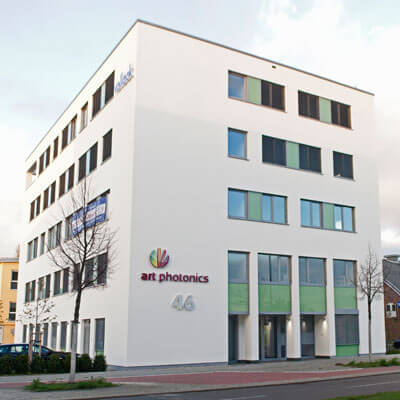
art photonics GmbH, founded in Berlin in September 1998, is one of the worldwide leaders in development and production of specialty fiber products for a broad spectrum from 300 nm to 16 µm. Unique technologies of Polycrystalline Mid InfraRed (PIR-) fibers and Metal coated Silica fibers are used for assembly of various spectroscopy probes for medical diagnostics and industrial process control, in volume production of fiber for medical and industrial lasers, for different fiber bundles, etc. Since January 2024 art photonics GmbH is a member of NYNOMIC GROUP.
Member Of:

Application Note: Air vs. Water: Finding the Optimal Reference for NIR Spectroscopy

Posted on: 
3 March 2026

The optimal choice of a spectral reference is important for building accurate calibration models. In our latest publication of Application Notes, art photonics explores the practical differences between using air and water as references in the quantitative analysis of liquid solutions.

NIR-spectroscopy is widely used for quantitative analysis of solid and liquid samples. When measuring liquid solutions in transmission or transflection geometry using a fiber optic probe, air and water (or another solvent) are the two commonly used reference samples. Both substances are widely available and reproducible in terms of their spectral properties.

To determine how each reference impacts calibration models, we conducted an experimental study using a designed set of 25 samples of a ternary aqueous mixture of ethanol and methanol. Measurements were performed in the 930-1720 nm range using an art photonics Transflection Fiber Probe coupled with a Broadcom Qneo spectrometer.

Key Findings from the Study

  • The Air Reference Workflow: Air can be preferred as a reference for its experimental simplicity. However, raw spectra are dominated by the strong signal of water. To build reliable partial least-squares (PLS) regression models, the data typically requires preprocessing - such as first or second derivatives by the Savitzky-Golay algorithm - to emphasize the vibration overtones of the alcohols.
  • The Water Reference Workflow: When water is used as a reference sample, the resulting spectra tend to be strongly distorted due to the presence of negative peaks (in place of the water signals). Although this makes the spectra less interpretable, their information content remains high, and their suitability for quantitative analysis is not impaired.
  • Impact on Data Analysis: Using the water sample spectrum as a reference measurement enables accurate prediction of the two alcohols under study without data preprocessing and with a lower number of latent variables. This results in a simpler, and hence, more reliable calibration model.

Conclusion

Both air and water can be successfully used for reference analysis in the analysis of aqueous solutions. While air offers experimental simplicity, using water as a reference simplifies data analysis by avoiding the spectral preprocessing step, which is required for air-based measurements.

Read the full methodology, view the raw and preprocessed spectra, and analyze the cross-validation statistics.

crossarrow-right
linkedin facebook pinterest youtube rss twitter instagram facebook-blank rss-blank linkedin-blank pinterest youtube twitter instagram
Copy link
Powered by Social Snap