During active pharmaceutical ingredient (API) crystallization and drying, comprehensive process understanding demands simultaneous insight into chemical composition and solid-state structure. Operators routinely track two distinct parameters in real time: residual solvent or moisture content, and crystal polymorphism. Historically, monitoring both attributes in situ presented a practical instrumentation bottleneck. Near-infrared (NIR) spectroscopy excels at quantifying water […]
The simultaneous quantitative determination of dissolved Cu²⁺, Co²⁺ and Ni²⁺ ions is important in many fields. These include metallurgy, geology, industrial wastewater analysis and the monitoring of biotechnological processes. In many cases, their concentrations need to be measured directly at the sampling site or in-line during an operating process. The Challenge of Metal Ion Monitoring […]
art photonics GmbH is currently exhibiting at the China International Optoelectronic Exposition (CIOE) 2026 in Shenzhen. From September 9-11, we are represented at this premier industry event by our partner, UniqueRay Technologies Limited. Industry professionals are invited to visit Stand 8B16 to review our advanced portfolio of specialty fiber optic solutions. UniqueRay is showcasing our […]
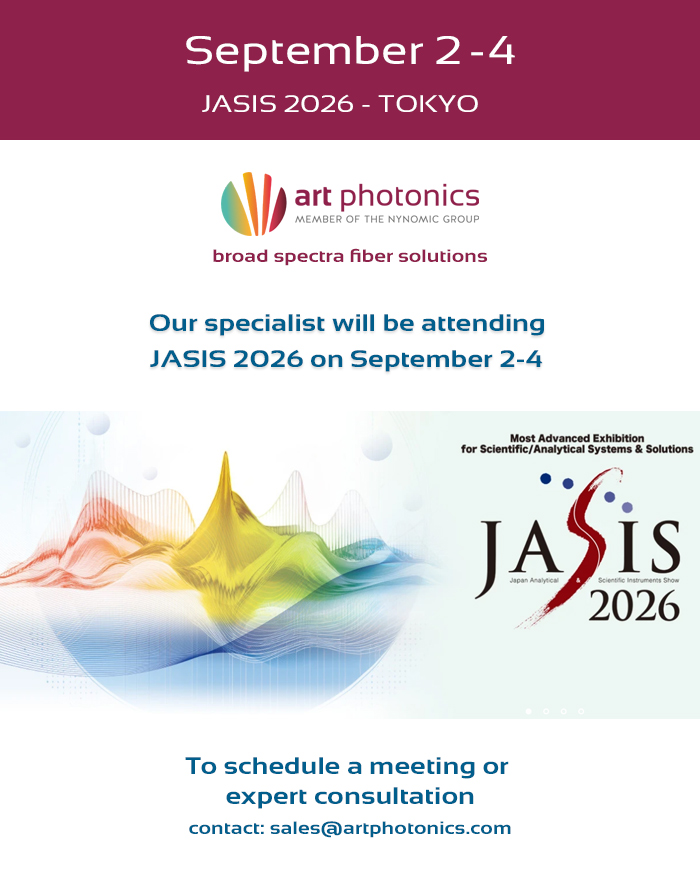
Day 1 Update: Meet Our Technical Representative Day 1 of JASIS 2026 is officially underway. Our technical representative and R&D Manager, Alexander Novikov, is on the ground at Makuhari Messe today and ready to connect with industry professionals. If you are looking to enhance your in-line process control, this is an excellent opportunity to speak […]
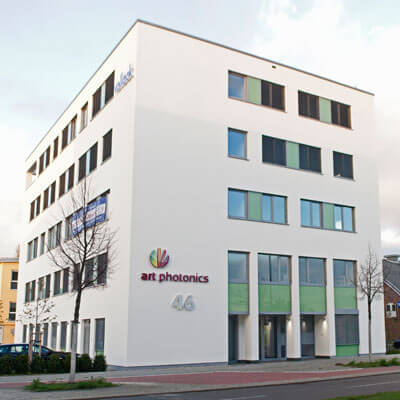
art photonics GmbH, founded in Berlin in September 1998, is one of the worldwide leaders in development and production of specialty fiber products for a broad spectrum from 300 nm to 16 µm. Unique technologies of Polycrystalline Mid InfraRed (PIR-) fibers and Metal coated Silica fibers are used for assembly of various spectroscopy probes for medical diagnostics and industrial process control, in volume production of fiber for medical and industrial lasers, for different fiber bundles, etc. Since January 2024 art photonics GmbH is a member of NYNOMIC GROUP.
art photonics GmbH is a German manufacturer of specialty optical fibers, fiber cables, fiber bundles and fiber-optic spectroscopy probes, founded in Berlin in September 1998. Its products cover the ultraviolet to mid-infrared range (0.2–18 µm).
art photonics is known for its proprietary polycrystalline silver halide (PIR) fibers, which transmit mid-infrared light from 3 to 17 µm, and for metal-coated silica fibers for high-temperature and vacuum use. Customers use art photonics products for in-line process spectroscopy (PAT), CO₂ and quantum cascade laser delivery, IR thermometry, IR imaging and medical diagnostics. art photonics has been part of the Nynomic Group since January 2024. More: About art photonics
What are FlexiSpec®, FlexiRay® and FlexiService?
FlexiSpec®, FlexiRay® and FlexiService are the three product lines of art photonics:
FlexiSpec®: fiber-optic spectroscopy probes (ATR, Raman, transflection, transmission, reflection, fluorescence and multichannel combi probes) and fiber probe couplers for FTIR spectrometers.
FlexiRay®: optical fibers, fiber cables, fiber bundles and accessories from UV to mid-infrared, including CO₂-laser delivery cables, vacuum feedthroughs and mid-IR bundles.
FlexiService: probe loan, installation and training, sample measurements, data treatment, repair, consulting and custom development.
Yes. art photonics GmbH is certified to DIN EN ISO 9001:2015, and its fibers, cables and probes are produced and tested in-house in Berlin. art photonics is also a member of EPIC (European Photonics Industry Consortium) and CPACT (Centre for Process Analytics and Control Technology). More: Quality control at art photonics
Does art photonics make custom fiber assemblies and OEM products?
Yes. art photonics designs and manufactures customized fibers, cables, bundles, probes and fiber sub-systems for OEM integration and research projects. Typical customizations include:
Cable, leg and probe shaft lengths
Connector types (SMA-905 standard; FC/PC and others on request)
Which optical fiber transmits mid-infrared light beyond 10 µm?
For flexible light guiding beyond 10 µm, the established options are polycrystalline silver halide (PIR) fibers and hollow waveguides; art photonics offers both. art photonics PIR fibers transmit from 3 to 17 µm, with losses of about 0.2–0.3 dB/m between 9 and 13 µm. This covers the 10.6 µm CO₂-laser line and the mid-IR fingerprint region used in molecular spectroscopy.
Glass fibers stop much earlier: silica transmits up to about 2.4 µm, fluoride glass up to about 5.5 µm and sulfide chalcogenide glass (As₂S₃) up to about 6.5 µm. More: Polycrystalline IR fibers
What is a PIR fiber (polycrystalline infrared fiber)?
A PIR fiber is a flexible core/clad optical fiber extruded from silver chloride–silver bromide (AgCl:AgBr) crystals rather than drawn from glass, which makes it transparent across the mid-infrared. art photonics developed a volume production technology for extruded core/clad PIR fibers. Key specifications of art photonics PIR fiber:
What is the difference between PIR, Chalcogenide, Fluoride and Hollow infrared fibers?
The four infrared fiber types differ mainly in transmission range, loss and handling. All four are available from art photonics.
Fiber type
Transmission range
Typical loss
Notes
Fluoride glass (InF₃, ZrF₄)
0.3–5.5 µm (InF₃), 0.3–4.5 µm (ZrF₄)
<10–15 dB/km
Single-mode and multimode; made by partner Le Verre Fluoré
Chalcogenide (CIR, As₂S₃)
1.1–6.5 µm
0.2–0.4 dB/m at 3–4 and 4.5–5 µm
Single-mode (8 µm core) to multimode (250 µm core)
Polycrystalline (PIR, AgCl:AgBr)
3–17 µm
0.2–0.4 dB/m at 10.6 µm
Stable transmission when bent; protect from light and metal contact
Hollow glass waveguide (HGW)
Selected bands within 3–17 µm
0.3–0.7 dB/m at 10.6 µm
No end-face Fresnel loss; NA 0.05; 1 dB loss per 360° loop at 400 mm diameter
In practice: fluoride for very low loss below 5 µm, chalcogenide for 2–6.5 µm, PIR for broadband mid-IR spectroscopy and the fingerprint region, and hollow waveguides for low-divergence laser beams. More: Optical fibers overview
What is chalcogenide (CIR) fiber used for?
art photonics chalcogenide infrared (CIR) fiber is an As₂S₃ glass fiber for the 1.1–6.5 µm range, used for mid-IR spectroscopy, flexible IR pyrometry, IR imaging and quantum cascade laser (QCL) delivery. Losses are 0.2–0.4 dB/m at 3–4 µm and 4.5–5 µm. A double polymer jacket (fluoropolymer + PVC) adds strength and flexibility, and the operating temperature is −273 °C to +90 °C.
Standard types are CIR8/300 (single-mode), CIR50/250 (few-mode) and CIR250/300 (multimode). art photonics also uses CIR fiber in ZrO₂ ATR probes for 1550–9000 cm⁻¹. More: Chalcogenide IR fibers
How should silver halide (PIR) fibers be handled?
PIR fibers must be kept away from UV and visible light and from contact with most metals. Light, including fluorescent room lighting, forms silver colloids in the AgCl:AgBr material and irreversibly increases optical loss. art photonics therefore recommends storing PIR fiber dry and dark and keeping fiber tips under opaque caps.
Contact with most metals causes a chemical reaction that damages both the fiber and the metal. Gold, silver, titanium, niobium, tantalum, platinum, polymers and dielectrics are safe. Work areas should be free of metal dust and SO₂-containing reagents. Repeated bending below a radius of 150× the fiber diameter causes plastic deformation and loss. Fiber surfaces can be cleaned with isopropanol or acetone. More: PIR fiber handling instructions (PDF)
What temperatures can art photonics optical fibers withstand?
The operating temperature range of art photonics fibers depends on the fiber type:
Fiber type
Operating temperature
Copper-alloy-coated silica
−270 °C to +600 °C (non-oxidizing atmosphere)
Aluminum-coated silica
−270 °C to +400 °C
Fluoride glass (InF₃, ZrF₄)
−180 °C to +150 °C
Polycrystalline (PIR)
−273 °C to +140 °C
Chalcogenide (CIR)
−273 °C to +90 °C
Hollow glass waveguide
−50 °C to +90 °C
For hot processes, art photonics high-temperature ATR probes operate up to +250 °C, and Raman probes up to +200 °C (+300 °C on request). More: Optical fibers overview
Laser delivery and special fibers
Can a CO₂ laser (10.6 µm) be delivered through a flexible optical fiber?
Yes. art photonics PIR fiber cables deliver CO and CO₂ laser radiation through a flexible fiber, optimized for 9.2 µm and 10.6 µm, with transmitted power up to 40 W. Standard CO₂-laser power thresholds are 10 W (PIR 400/500), 20 W (PIR 600/700) and 35 W (PIR 900/1000).
A SMART end-face treatment (Special Micro Anti-Reflection Treatment) suppresses Fresnel reflection and raises output power by 10–12%. Unlike hollow waveguides, PIR cables keep stable transmission when bent. Cables are up to 5 m long, use SMA-905 connectors with titanium ferrules and operate from −50 °C to +80 °C. Typical uses are medical CO₂ lasers and industrial laser cutting and treatment. More: Fiber delivery for CO and CO₂ lasers
What are metal-coated silica fibers used for?
Metal-coated silica fibers are used where polymer-coated fibers fail: high temperature, high vacuum, harsh chemicals and repeated sterilization. art photonics copper-alloy-coated fibers operate from −270 °C to +600 °C (in non-oxidizing atmospheres), and aluminum-coated fibers up to +400 °C.
Both types transmit 220–2400 nm depending on the UV or NIR silica core, do not outgas in high vacuum and tolerate up to 100% humidity. They can be soldered into connectors without epoxy and sterilized by steam, EtO, e-beam or gamma radiation. Core diameters range from 9 µm (single-mode) to 600 µm. Applications include down-hole sensing in oil and gas, radiation-resistant devices for the nuclear industry, high-power laser delivery, medical devices and soldered fiber bundles. More: Copper-coated silica fibers · Aluminum-coated silica fibers
How can an optical fiber be passed into a vacuum or pressure chamber?
art photonics FlexiRay® vacuum fiber-optic feedthroughs carry light from 0.2 to 18 µm into vacuum or pressurized chambers, from 10 bar down to 10⁻⁷ Torr, with a leak rate better than 5×10⁻¹² mbar·l/s. They fit any flange type. Silica fiber feedthroughs are available for all core sizes from single-mode to 1000 µm, and a Cu-coated version withstands up to 600 °C.
For mid-IR chalcogenide and PIR fibers, the whole cable passes through the flange without a splice, because jointing a short fiber piece would cause high coupling losses. The cable can slide through the flange to adjust its length inside the chamber. More: Vacuum fiber-optic feedthrough
Fiber-optic spectroscopy probes
What is a fiber-optic ATR probe and how does it work?
A fiber-optic ATR (attenuated total reflection) probe brings infrared spectroscopy directly into a reactor or pipeline. Optical fibers guide light to an ATR crystal at the probe tip, where it is totally internally reflected. The evanescent field penetrates about 0.5–2 µm into the surrounding sample, and the attenuated light returns through the fibers to the spectrometer.
Because the optical path is so short, ATR probes measure strongly absorbing and opaque liquids, slurries and aqueous media without sample preparation or extraction. art photonics FlexiSpec® ATR probes use PIR, CIR or silica fibers depending on the spectral range. They have Hastelloy C22 shafts (6.3 or 12 mm diameter, 100–700 mm long), a patented tip design with no dead zone, and SMA-905 connectors. More: Fiber-optic ATR probes · Technical note: How does an ATR probe work? (PDF)
Which ATR crystal should I choose: diamond, silicon, germanium, ZrO₂ or sapphire?
Choose the ATR crystal by spectral range first, then by pressure and temperature. Ratings of art photonics standard immersion ATR probes:
What temperature and pressure can art photonics ATR probes withstand?
Standard art photonics FlexiSpec® ATR probes operate from −150 °C to +140 °C (diamond, silicon) or +200 °C (ZrO₂ and sapphire with silica fiber). With a diamond crystal they withstand up to 200 bar, or 300 bar on request.
ATR probes for harsh environments operate from −150 °C to +250 °C with diamond, silicon or ZnSe crystals, using air cooling (0.5 bar excess pressure, 2300 l/h) and internal temperature control of the ATR tip. Their pressure ratings are 200 bar (diamond), 100 bar (silicon, ZrO₂) and 10 bar (ZnSe). More: ATR probes for harsh environments
Which spectrometers can be used with art photonics fiber probes?
art photonics FlexiSpec® probes work with FT-IR, FT-NIR, NIR, UV-Vis and Raman spectrometers, photometers, and IR-LED or QCL-based sensors, connected via SMA-905 (or FC/PC for Raman) connectors. For FTIR spectrometers without a fiber port, art photonics fiber probe couplers mount in the sample compartment. Their mirror optics cover 0.2–18 µm.
art photonics FlexiSpec® Raman fiber probes are bifurcated in-line probes that connect to a laser and any Raman spectrometer. They come with single-wavelength excitation (532 or 785 nm standard) or multi-wavelength excitation (630–785 nm, e.g. dual 680 + 785 nm lasers); other laser lines from 405 to 1064 nm are available on request.
The probes cover the fingerprint (800–1800 cm⁻¹) and high-wavenumber (2800–3800 cm⁻¹) ranges, with laser rejection above optical density 6 and over 95% transmission of the Raman signal. They have AR-coated sapphire windows and stainless steel shafts (12 mm or 6 mm OD), and operate from −20 °C to +200 °C (+300 °C on request) at up to 100 bar. A 3-A hygienic version and a needle Raman probe are also available. More: Raman fiber probe
Can one probe measure mid-IR, NIR and Raman spectra at the same time?
Yes. The art photonics ATR-Raman-Transflection multichannel probe combines three channels in one 25 mm Hastelloy C22 shaft, spaced about 10 mm apart:
Mid-IR ATR: silicon crystal (3.2–17 µm) or diamond crystal (5.2–17 µm), via silver halide fibers
NIR transflection: 900–2500 nm, 2 mm optical path
Raman: 100–3200 cm⁻¹ with 785 nm excitation
The probe operates at 0–10 bar and 0–120 °C at the shaft; a two-channel ATR + transflection version is also available. For powders and slurries, the NIRaman Combi Probe combines an NIR diffuse-reflectance channel and a 785 nm Raman channel in a single 19 mm shaft. More: ATR-Raman-Transflection multichannel probe · NIRaman Combi Probe
Which fiber probe is suitable for hygienic pharmaceutical and food processes?
The art photonics 3A-certified transflection fiber probe is designed for the highest hygienic requirements in pharmaceutical, food and beverage processing. It has an electropolished 316L stainless steel shaft, gold-soldered (Au/Sn) sealing, sapphire optics and food-grade conduit and fittings.
It measures in the UV-Vis (0.2–1.3 µm) or Vis-NIR (0.4–2.2 µm) with a standard 1 mm optical path (0.5 mm gap); 4, 10 or 20 mm paths are available on request. It operates from +5 °C to +200 °C at up to 100 bar. Raman probes are available in a 3-A version on request, and the NIRaman Combi Probe comes in pharma-grade configurations with sanitary process connections. More: 3A-certified transflection probe
Which probe type should I use: ATR, transflection, diffuse reflection or Raman?
The right probe type depends on the sample:
ATR (mid-IR): strongly absorbing or opaque liquids, aqueous solutions, slurries and polymerization mixtures; highest chemical specificity in the fingerprint region.
Transflection or transmission (UV-Vis-NIR): clear to moderately turbid liquids, with a selectable optical path.
Diffuse reflection (NIR): powders, granules and solids.
Raman: aqueous systems and solid-state form (polymorphs, hydrates), measured through a sapphire window.
Multichannel probes: when one reactor port must deliver several techniques at once.
Applications and process analytical technology (PAT)
How can a chemical reaction be monitored in real time with infrared spectroscopy?
A chemical reaction can be monitored in real time by immersing a fiber-optic ATR probe in the reactor and connecting it to an FTIR or NIR spectrometer, which records spectra continuously without sampling. art photonics FlexiSpec® ATR probes are used this way for reaction monitoring, polymerization control and crystallization screening. They run in lab reactors, pilot plants and production in the chemical, petrochemical, nuclear, biopharmaceutical and food industries.
In-line measurement replaces offline sampling and lab analysis, so deviations show up while the batch is still running. An existing FTIR spectrometer can be upgraded for in-line work with an art photonics fiber probe coupler. More: Eliminating offline sampling delays with FlexiSpec® ATR probes
Can mid-infrared fiber probes monitor fermentation and bioprocesses?
Yes. In a study by art photonics with partners including Ulm and Aalen Universities of Applied Sciences, mid-IR ATR fiber probes on PIR fibers monitored ethanol, glucose and fructose during Saccharomyces cerevisiae fermentation. With a diamond ATR probe and an FT-IR spectrometer, the prediction error (RMSE) was about 4–6 g/L for ethanol–glucose and 1–2 g/L for glucose–fructose calibration mixtures, using only the 950–1150 cm⁻¹ region.
Mid-IR ATR distinguished glucose from fructose, which NIR transflection could not do reliably in water. A PIR-loop ATR probe, three to five times cheaper than a diamond probe, worked with a compact pyroelectric grating spectrometer; its detachable head suits single-use bioreactors. ATR does not measure biomass, because the evanescent field reaches only 0.5–2 µm into the broth. Published in Sensors and Actuators B: Chemical 221 (2015) 1601–1610. More: Application note AN001 (PDF)
How can moisture and polymorphism be monitored during API crystallization and drying?
NIR spectroscopy quantifies water and residual solvent, while Raman spectroscopy distinguishes polymorphs, hydrates and amorphous phases; the art photonics NIRaman Combi Probe measures both through a single reactor port. It integrates an NIR diffuse-reflectance channel and a 785 nm Raman channel in one 19 mm shaft. Both channels record synchronized spectra from the same sample volume without optical cross-talk, in powders, crystalline slurries and liquids.
Applications include API crystallization and drying, raw material identification, blend uniformity and reaction kinetics. Laboratory and pharma-grade versions with sanitary process connections are available. More: Dual-channel process monitoring with NIR and Raman · NIRaman Combi Probe
Which industries use art photonics products?
art photonics fibers, cables and probes are used in:
Chemical and petrochemical processing: in-line reaction and polymerization monitoring
Pharmaceutical and biopharmaceutical manufacturing: PAT, crystallization, fermentation
Food and beverage: hygienic in-line probes
Nuclear industry: in-situ IR spectroscopy and radiation-resistant metal-coated fibers
Oil and gas: down-hole sensing with metal-coated fibers
Medical devices and diagnostics: CO₂-laser delivery, sterilizable fibers, fluorescence probes
Industrial laser processing: laser cutting and treatment
Research, space and environmental sensing: vacuum feedthroughs, mid-IR bundles, IR imaging and pyrometry
Can I test an art photonics fiber probe before buying it?
Yes. art photonics lends standard fiber-optic probes for evaluation on a monthly loan basis, or delivers them short-term for demonstrations. Alternatively, customers can send samples to art photonics, whose lab staff measure them with a suitable fiber-optic system and report the results. Installation, on-site training and spectral data treatment are also available. More: FlexiService
Does art photonics repair fiber probes and cables?
Yes. art photonics repairs every product in its catalog, including damaged probes, cables and bundles. It also accepts repair requests for fiber-optic products from other manufacturers. Send the product type and a description of the damage to sales@artphotonics.com. More: Repair service
How do I request a quote or technical advice from art photonics?
Contact art photonics GmbH by email at sales@artphotonics.com, by phone at +49 30 6779 887-0, or through the inquiry form on any product page. The art photonics team advises on fiber type, probe type, ATR crystal and accessories, and quotes standard or customized configurations. Outside Germany, art photonics also works through regional partners, such as UniqueRay Technologies in China. More: Contact
You are currently viewing a placeholder content from Turnstile. To access the actual content, click the button below. Please note that doing so will share data with third-party providers.