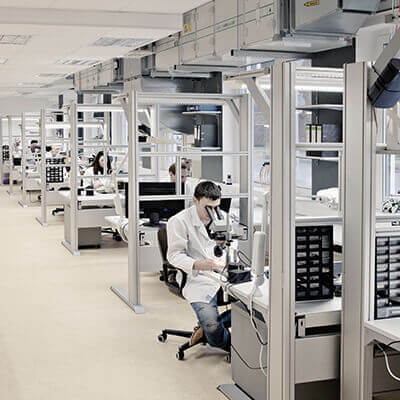
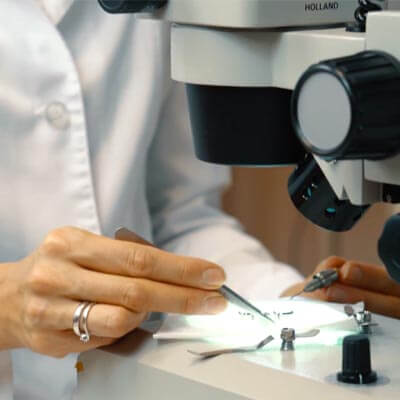
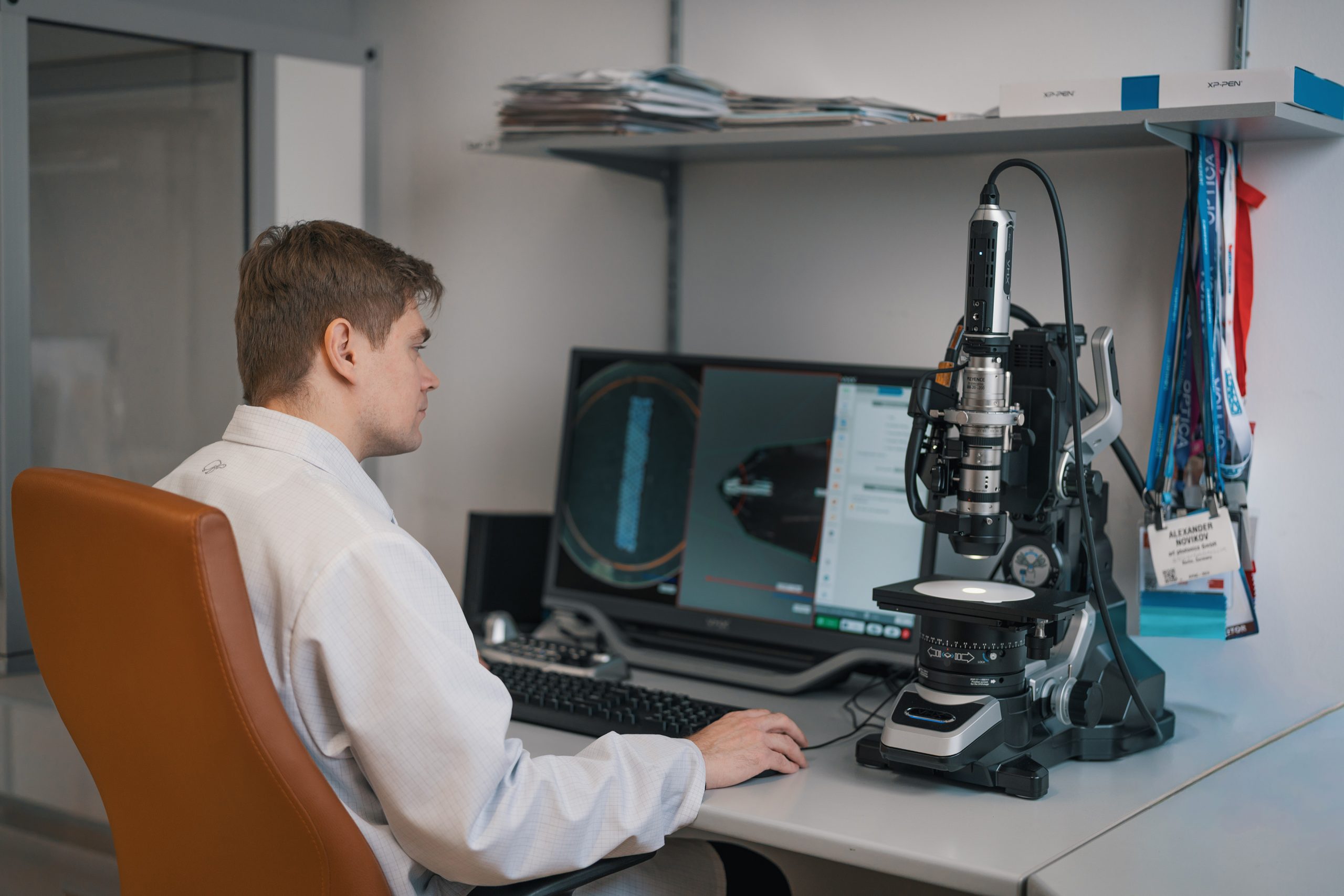
Every fiber, cable, and probe that leaves our Berlin facility gets put under a microscope. Literally.
Before a product ships, we inspect the fiber end faces for cracks and contamination, check core/clad geometry, and verify transmission against spec. On mid-IR assemblies, that means confirming losses stay within 0.2–0.3 dB/m in the 9–13 µm range — a number that only holds if every step upstream, from fiber draw to final assembly, was done right. It's slow, it's manual, and it's the reason our fibers perform exactly as the datasheet says they will.
Made in Germany, from raw fiber to finished part
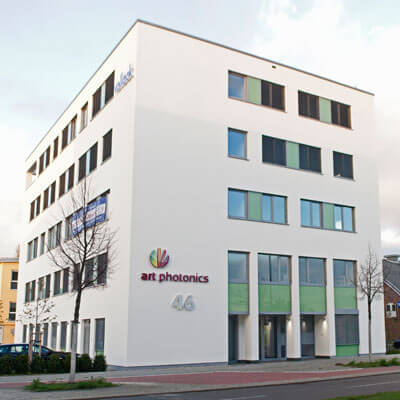
That inspection work happens in-house, in Germany, under ISO 9001 — and has for over 25 years. We draw the fiber, build the cables and probes, and test them all under one roof. Nothing gets waved through on the strength of a supplier's word, because there's no external supplier in the chain to take on faith.
Where standard fiber runs out
Our real point of difference is the mid-IR. Beyond roughly 2.5 µm, standard silica fiber stops transmitting altogether. Our patented polycrystalline silver-halide (PIR) fibers carry light out to 18 µm, making them one of the few fiber options that are flexible, non-toxic, and non-hygroscopic at those wavelengths. That's what allows us to cover 200 nm to 18 µm — UV through mid-IR — from a single manufacturer:
- Specialty fibers: silica, chalcogenide, and polycrystalline silver halide
- Custom fiber optic cables and laser delivery assemblies
- Fiber bundles for imaging, illumination, and light delivery
- ATR, transflection, and Raman probes for in-line process control
Built for where the measurement actually happens
Our probes are designed for the harder end of the job — reactors, pipelines, and aggressive chemistry — for applications where it makes more sense to bring the spectrometer to the sample than the sample to the lab. That's why they're widely used in biopharma, chemical and petrochemical processing, and environmental monitoring, wherever real-time, in-line analysis has to hold up under demanding process conditions.
If you're working on a mid-IR measurement that standard silica can't handle, that's exactly the problem we specialize in solving. Get in touch, or browse our product range to see what's possible.