The simultaneous quantitative determination of dissolved Cu²⁺, Co²⁺ and Ni²⁺ ions is important in many fields. These include metallurgy, geology, industrial wastewater analysis and the monitoring of biotechnological processes. In many cases, their concentrations need to be measured directly at the sampling site or in-line during an operating process.
The Challenge of Metal Ion Monitoring
Copper, cobalt and nickel are widely used in alloy production, electroplating, battery technologies and other industrial applications. Reliable determination of Cu²⁺, Co²⁺ and Ni²⁺ is important for wastewater monitoring and process control for two primary reasons:
- Environmental Safety: Mining and industrial processing of these metals can generate wastewater containing dissolved metal ions, which must be monitored because elevated concentrations may harm aquatic ecosystems.
- Biotechnological Control: These elements also serve as trace nutrients in selected biotechnological processes.
Although traditional methods such as atomic absorption spectroscopy, inductively coupled plasma techniques, electrochemical analysis and laboratory spectrophotometry can provide high sensitivity and selectivity, they do not always meet the requirements of rapid analysis because they commonly require sampling and sample preparation. For field and process applications, analysis at the sampling site with minimal sample preparation or directly in-line without sampling is therefore desirable.
The Fiber-Optic Spectroscopy Solution
Visible absorption spectroscopy is well suited to the determination of Cu²⁺, Co²⁺ and Ni²⁺ because these ions exhibit characteristic absorption bands in the visible region. Characteristic spectral signatures in the visible region allow their measurement using compact spectrometers and fiber-optic probes.
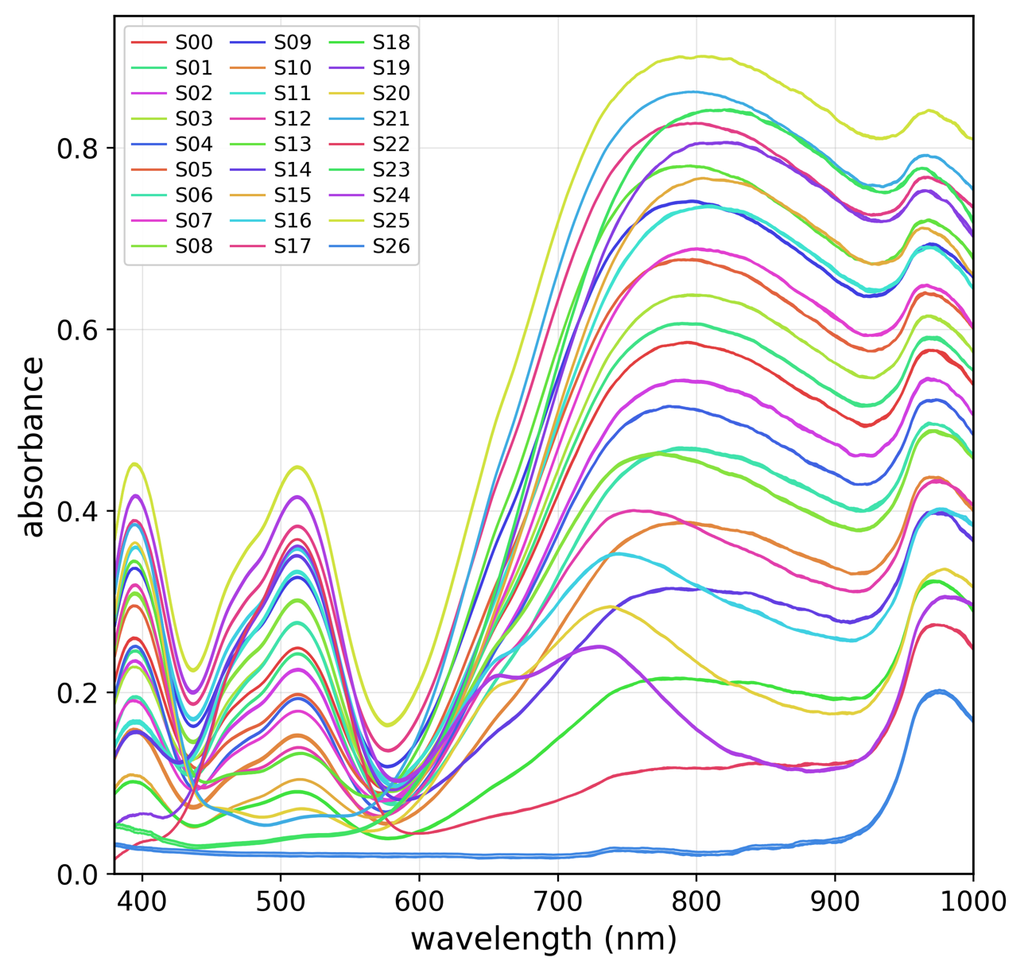
However, substantial overlap between the absorption bands makes simultaneous determination of the three ions difficult using conventional single-wavelength photometric measurements. Combined with multivariate calibration, this equipment extracts concentration information from the full spectrum and thus enables the analysis of complex mixtures without prior separation.
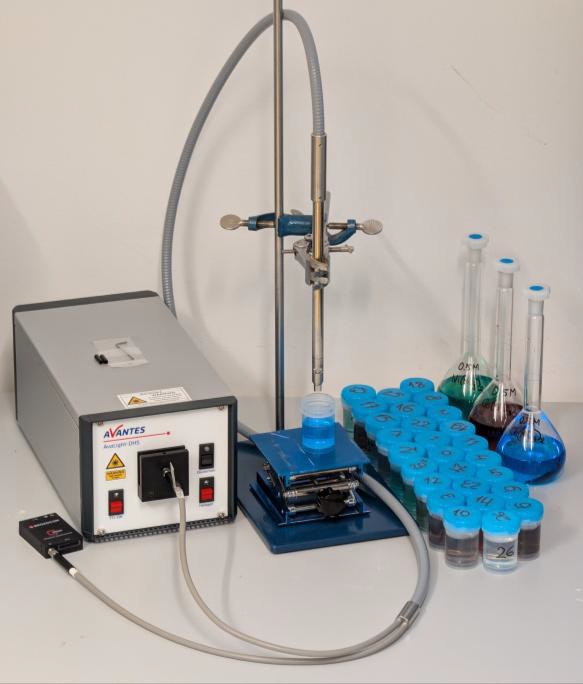
Figure 1. Measurement setup with a Transflection fiber-optic probe (art photonics GmbH) with an adjustable optical path length.
Methodology and Experimental Setup
In this application note, absorbance spectra of ternary aqueous solutions of copper(II), cobalt(II) and nickel(II) nitrates were measured in the visible and short-wave near-infrared regions using a fiber-optic transflection probe (art photonics GmbH, Germany) and a compact slit-type spectrometer.
- Optical Path Length: Set to 10.0 mm.
- Illumination: Provided by an AvaLight-DH-S halogen light source (Avantes BV, the Netherlands).
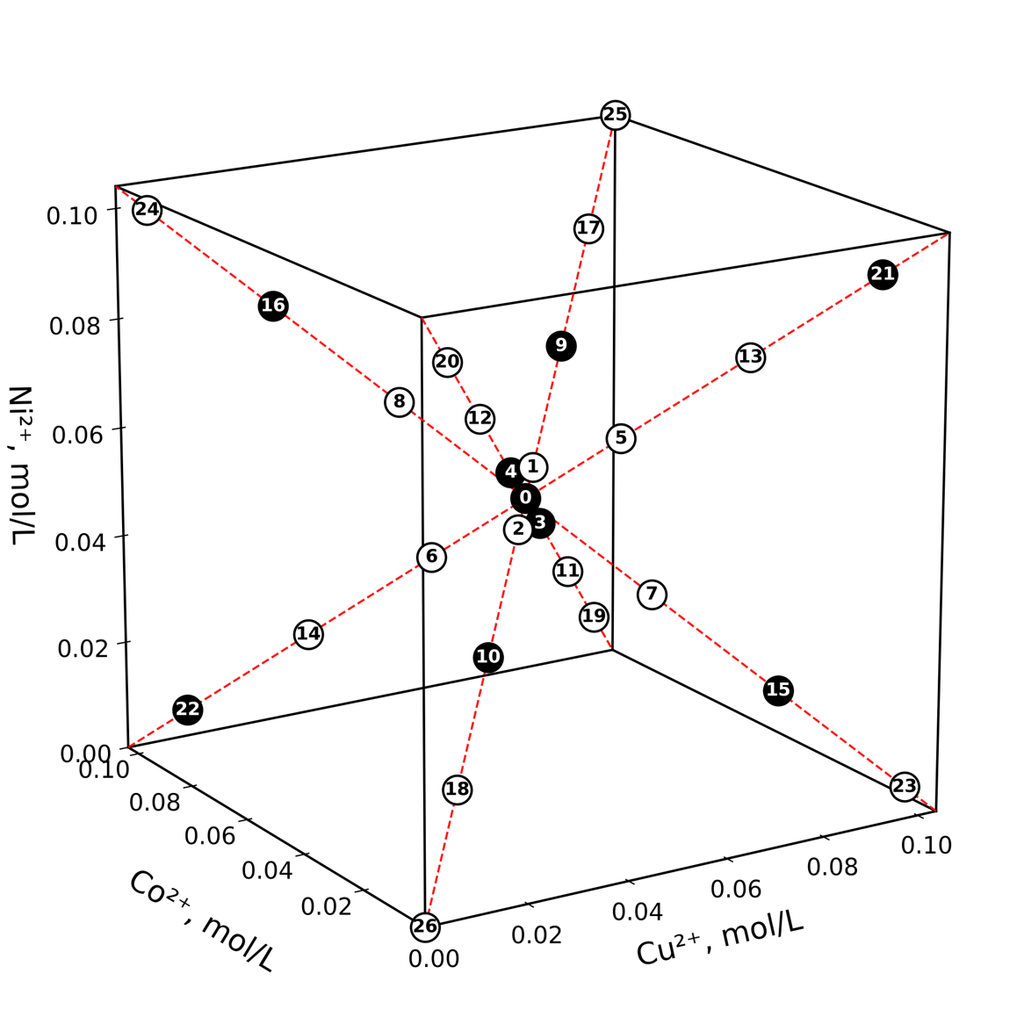
- Samples: A calibration set of 27 ternary aqueous solutions (25.0 mL each) was prepared from the hydrated metal nitrates Cu(NO₃)₂·3H₂O, Co(NO₃)₂·6H₂O and Ni(NO₃)₂·6H₂O according to a diagonal experimental design.
- Reference: The reference spectrum was recorded in air without a sample.
Figure 2. Diagonal experimental design for ternary aqueous mixtures of copper(II), cobalt(II) and nickel(II) nitrates [A. Bogomolov, Anal. Chim. Acta 951 (2017) 46-57]. Open and filled circles represent training and validation samples, respectively; labels indicate sample numbers.
Figure 3. Absorbance spectra of the 27 designed copper(II), cobalt(II) and nickel(II) nitrate solutions. The spectra were smoothed using the Savitzky-Golay algorithm. The three replicate spectra for each sample are plotted in the same colour.
Calibration Models
The resulting spectra were analysed, and a partial least squares regression model for multiple response variables (PLS2) was developed to determine the concentrations of all three metal ions from a single spectrum of an unknown mixture.
Five latent variables (LVs) were required to obtain accurate and robust calibration models for all three metal ions:
- Three LVs were associated with variations in metal concentrations.
- Two LVs may be related to weak spectral effects known to arise from metal-nitrate interactions and salt-induced changes in the water absorption band near 970 nm.
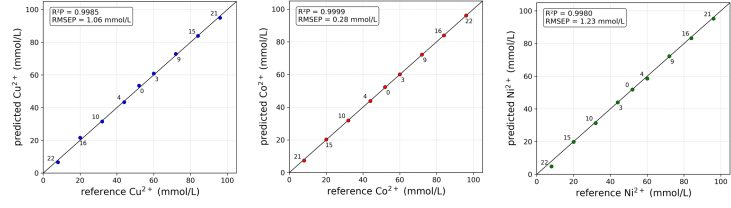
Figure 4. Predicted versus reference concentrations for Cu²⁺ (top), Co²⁺ (middle) and Ni²⁺ (bottom) in the validation set obtained with the five-latent-variable PLS2 model.
Results and Conclusion
The proposed method enables simultaneous determination of copper(II), cobalt(II) and nickel(II) from a single spectrum recorded over the 380-1000 nm range. Simultaneous determination was achieved over concentration ranges of up to approximately 0.10 mol/L (100 mmol/L or 0.6% m/v), with prediction errors of approximately 0.3-1.2 mmol/L.
The obtained results point to the possibility of achieving low detection limits for all three analytes. The broad working range and high prediction accuracy make the method suitable for various practical applications. The proposed approach can be implemented as a compact optical system for rapid field analysis and wastewater monitoring, as well as for in-line process analysis in industrial and biotechnological applications.
Read the full text of the Application Note here.