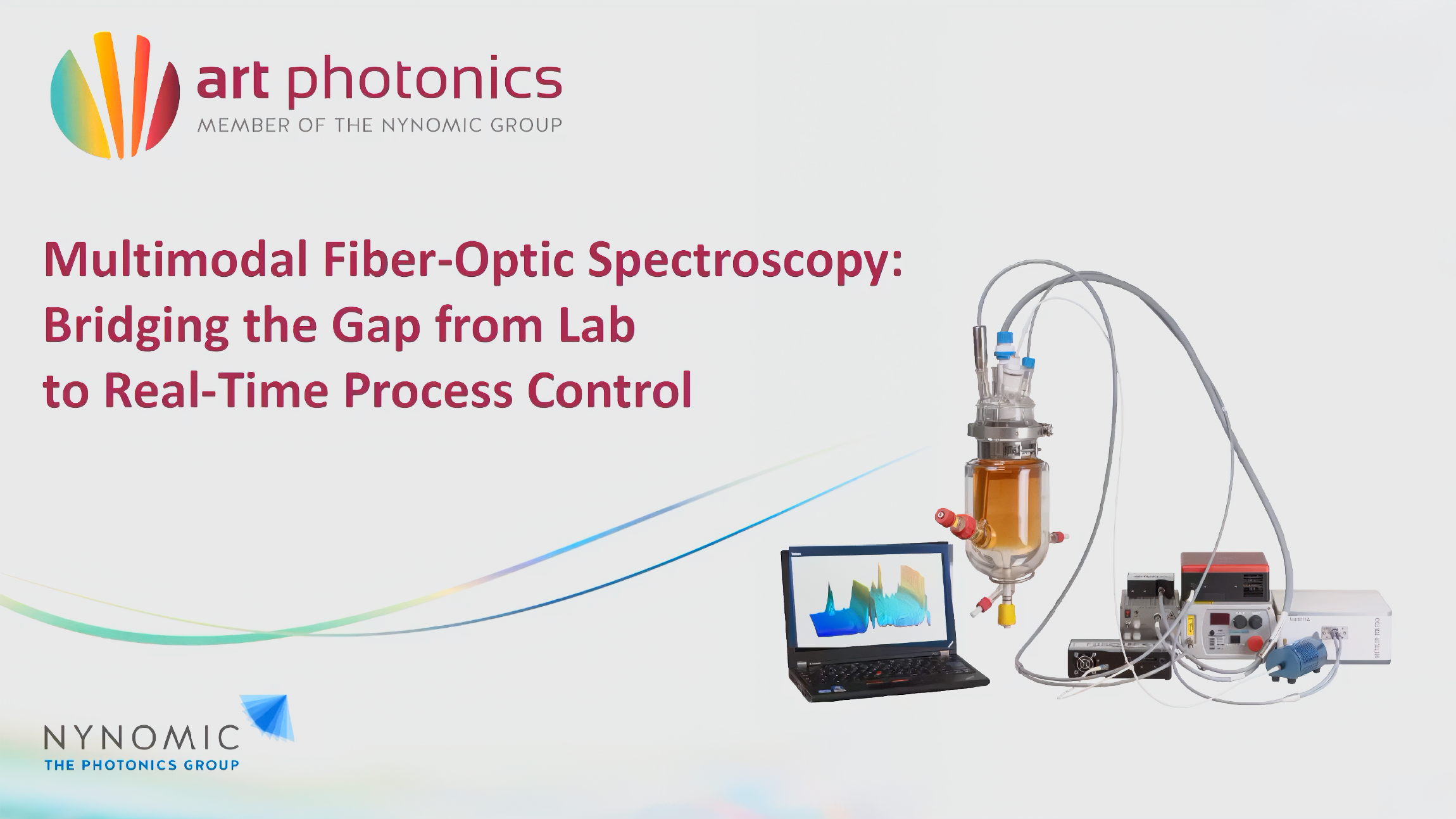
Our R&D Manager Dr. Alexander Novikov presented the webinar “Multimodal Fiber Optic Spectroscopy: Bridging the Gap from Lab to Real-Time Process Control” on 11 June 2026 as part of the CPACT webinar series. CPACT, the Centre for Process Analytics and Control Technology, is a leading international community focused on Process Analytical Technology (PAT) and advanced process analytics.
The webinar highlights fiber optic spectroscopy solutions for PAT applications, including ATR, Raman and combined measurement approaches. Watch the full recording below.
You are currently viewing a placeholder content from YouTube. To access the actual content, click the button below. Please note that doing so will share data with third-party providers.
More Information In-line process monitoring instead of grab samples
A grab sample shows what was in the reactor when it was drawn. A fiber-optic probe shows what is in it now. Only the passive probe sits in the reactor, pipeline or vessel; the spectrometer stays outside, connected by fiber. Nothing has to be drawn, transported or prepared, so the data arrive while the process can still be adjusted.
Our FlexiSpec® probes are built for process conditions. ATR probes for harsh environments are rated up to +250 °C and 200 bar, and our Raman probes up to +200 °C (300 °C on request) and 100 bar. Both fit automated process interfaces.
One port, several techniques: ATR, Raman and combi probes
Multimodal spectroscopy measures the same sample with more than one technique, and each technique sees something different. Mid-IR ATR is most sensitive to polar bonds such as C=O, O–H and N–H. Raman picks up symmetric and non-polar bonds and works well in water. NIR quantifies moisture and solvent content.
Free process ports are scarce, so we combine techniques in a single probe shaft:
- NIRaman Combi Probe: NIR diffuse reflectance and 785 nm Raman in one 19 mm shaft, for example in pharmaceutical process analytics, to follow residual moisture and polymorphic form during API crystallization and drying.
- ATR-Raman-Transflection Probe: ATR, Raman and transflection channels in one probe.
- Other combinations, such as mid-IR ATR with fluorescence, on request.
When the channels acquire simultaneously, as in the NIRaman probe, their spectra can be fused into one chemometric model. Our Technical Note 006 (PDF) compares mid-IR ATR and Raman for in-line use.
Fibers for every part of the spectrum
Each channel needs a fiber that carries its wavelength range. Silica fibers cover UV to NIR but stop transmitting at around 2.5 µm. For the mid-IR we use chalcogenide (CIR) fibers and our own polycrystalline silver-halide (PIR) fibers, which we extrude in Berlin. Together they cover 0.2–18 µm.
We have designed and built fibers, cables and probes in Berlin since September 1998: more than 25 years of German engineering, with ISO 9001-certified production.
Related products
Planning to move a lab method in-line? Send your process conditions (temperature, pressure, medium) and your spectrometer model to sales@artphotonics.com, and we will suggest a probe configuration. Standard probes are also available on loan for evaluation.
Thank you to CPACT for hosting the session. As members, we are glad to contribute to the webinar series.