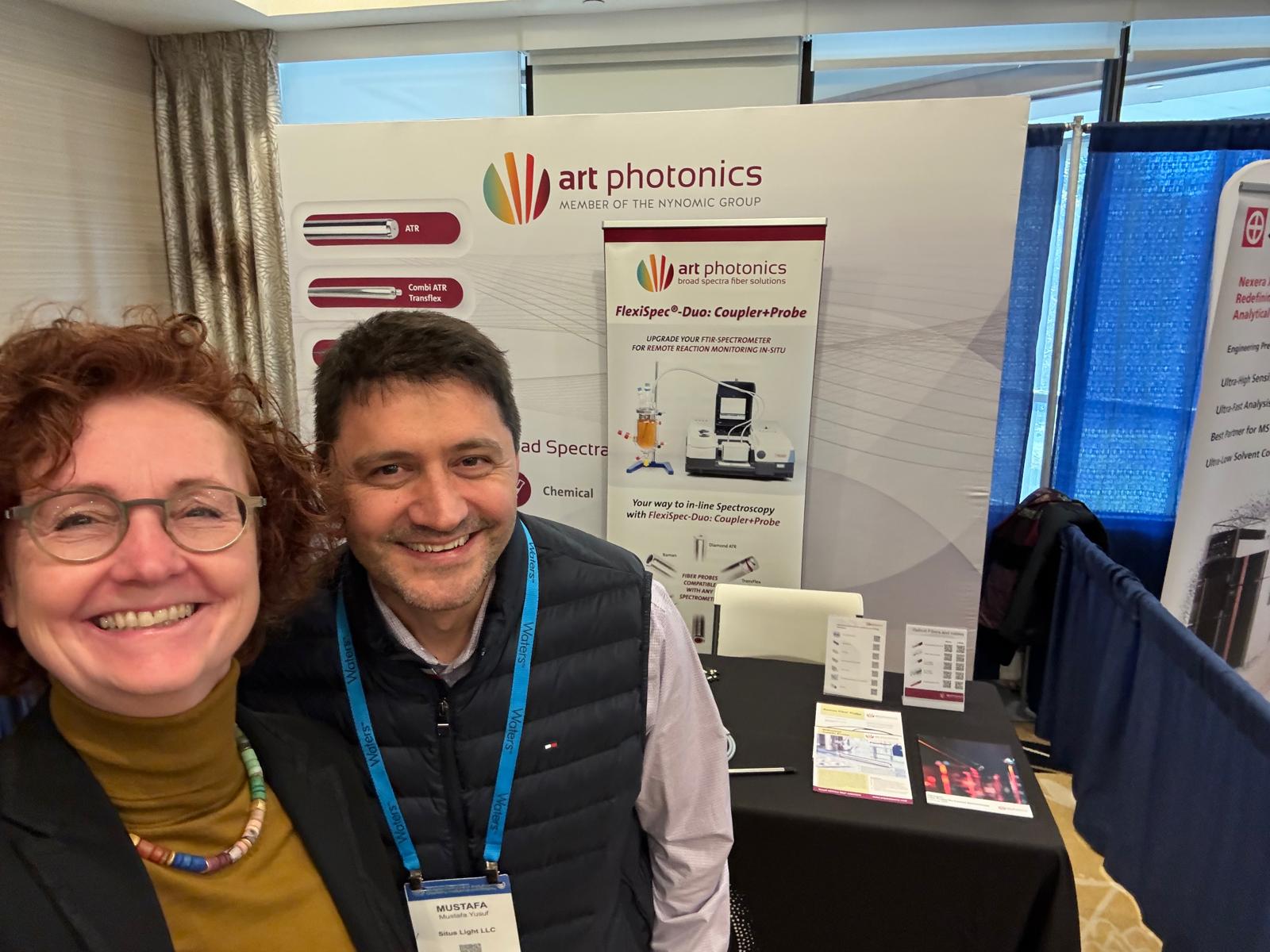
Our CEO, Dr. Stefanie Foerster, represented art photonics at the Eastern Analytical Symposium & Exposition (EAS 2026), held 16–18 November 2026 at the Crowne Plaza Princeton Conference Center in Plainsboro, New Jersey. As announced, she joined our close partner Mustafa Yusuf at the Situs Light booth, #L1. Thank you to everyone who stopped by, from researchers to OEMs and industry colleagues, for the conversations about fiber-optic spectroscopy.
Forensic spectroscopy: the fingerprint region, measured at the sample
In the forensic science sessions, speakers agreed that the mid-IR fingerprint region, below about 1500 cm⁻¹, carries the most information for identifying a material. Fiber-coupled ATR, which takes the measurement to the sample instead of the sample to the spectrometer, still seems underrated in forensic work.
Part of the reason is the fiber. Silica fibers stop transmitting at around 2.5 µm, well short of the fingerprint region. Our FlexiSpec® fiber optic ATR probes use our own polycrystalline silver-halide (PIR) fibers, which we extrude in Berlin and which transmit up to 18 µm (about 550 cm⁻¹).
Vibrational spectroscopy: is ATR too costly and tedious?
The vibrational spectroscopy session compared techniques for everyday industrial use, and we heard ATR described as too costly and tedious. That is a fair description of bench ATR, where every measurement means drawing a sample, loading it and cleaning the crystal.
In-line ATR removes those steps. A fiber optic ATR probe stays in the reactor and measures continuously. Our ATR probes for harsh environments are rated up to +250 °C and 200 bar.
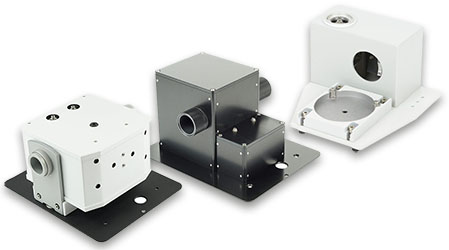
The FlexiSpec®-Duo: Coupler+Probe connects that probe to the FTIR you already own. A fiber probe coupler sits in the spectrometer's sample compartment, and only the probe goes into the process. Our couplers fit FTIR spectrometers from Thermo Fisher Scientific, Bruker, JASCO, Shimadzu, Agilent and PerkinElmer, with customized baseplates for other models. In-line process monitoring does not have to start with a dedicated process analyzer.
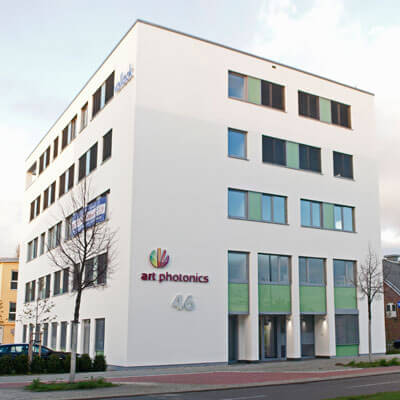
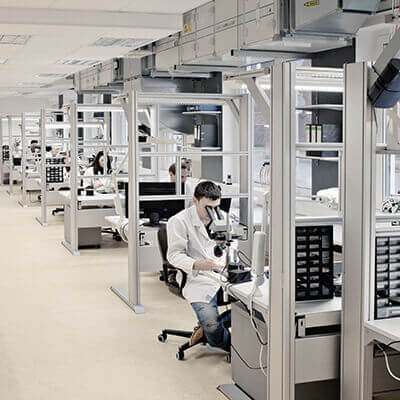
We have designed and built fibers, cables and probes in Berlin since September 1998.
Related products
Missed us in Plainsboro? Send your sample type or process conditions (temperature, pressure, medium) and your FTIR model to sales@artphotonics.com, and we will suggest a probe and coupler configuration. Standard probes are also available on loan for evaluation.
Thank you to the EAS organizers, and to Mustafa Yusuf and Situs Light for sharing their booth with us.